
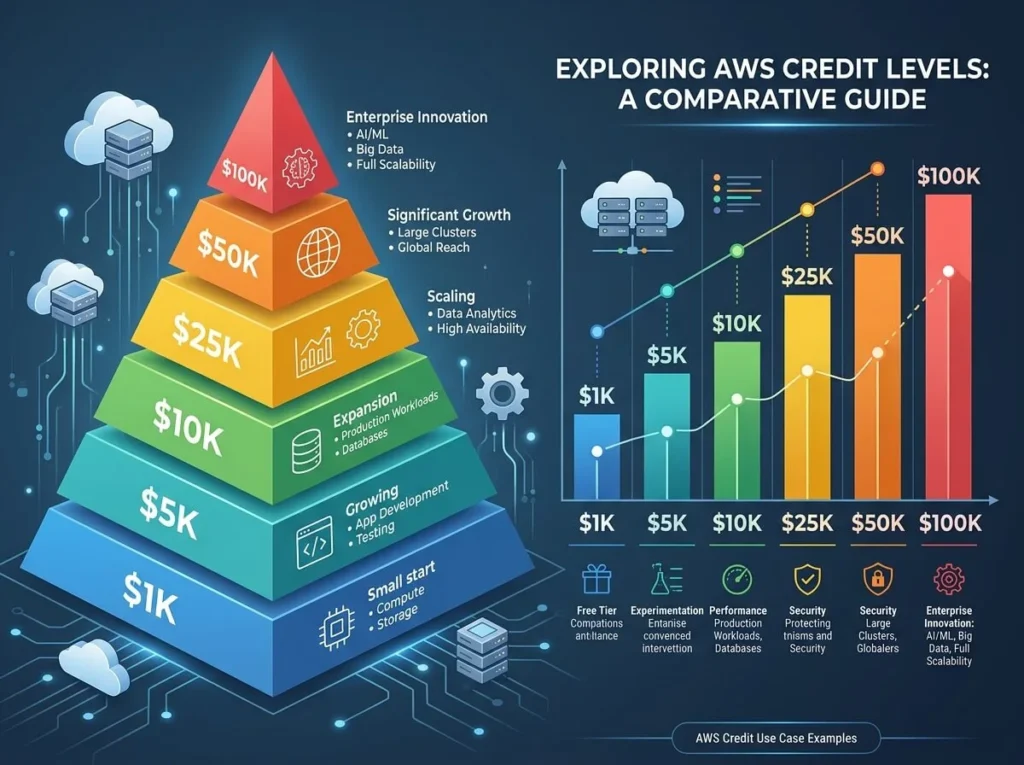
AWS credit accounts range from $1,000 to $100,000 and are mostly offered through AWS Activate for startups. Smaller tiers (1K–5K) suit early-stage founders testing ideas, while larger tiers (25K–100K) fit funded startups scaling infrastructure. Your eligibility usually depends on your funding stage and whether you’re backed by an approved accelerator, incubator, or VC.
AWS credits can shave thousands off your cloud bill—if you know which tier you qualify for and how to use it well. Many founders sign up for the wrong tier, let credits expire, or burn through them faster than expected.
This guide breaks down each AWS credit level, who it’s built for, and how to make the most of it. By the end, you’ll know exactly which tier fits your stage and how to stretch every dollar.
What are AWS credits and how do they work?
AWS credits are promotional balances applied to your Amazon Web Services bill. They offset costs for services like EC2 (compute), S3 (storage), RDS (databases), and many others. When you incur eligible charges, AWS deducts the amount from your credit balance before charging your payment method.
Most credits come through AWS Activate, a program designed for startups. Credits typically expire after one to two years, and some apply only to specific services. Reading the terms attached to your credit package matters just as much as the dollar amount.
Keep in mind that credits don’t usually cover every charge. Certain services, taxes, and third-party Marketplace purchases may be excluded.
How do the AWS credit tiers compare?
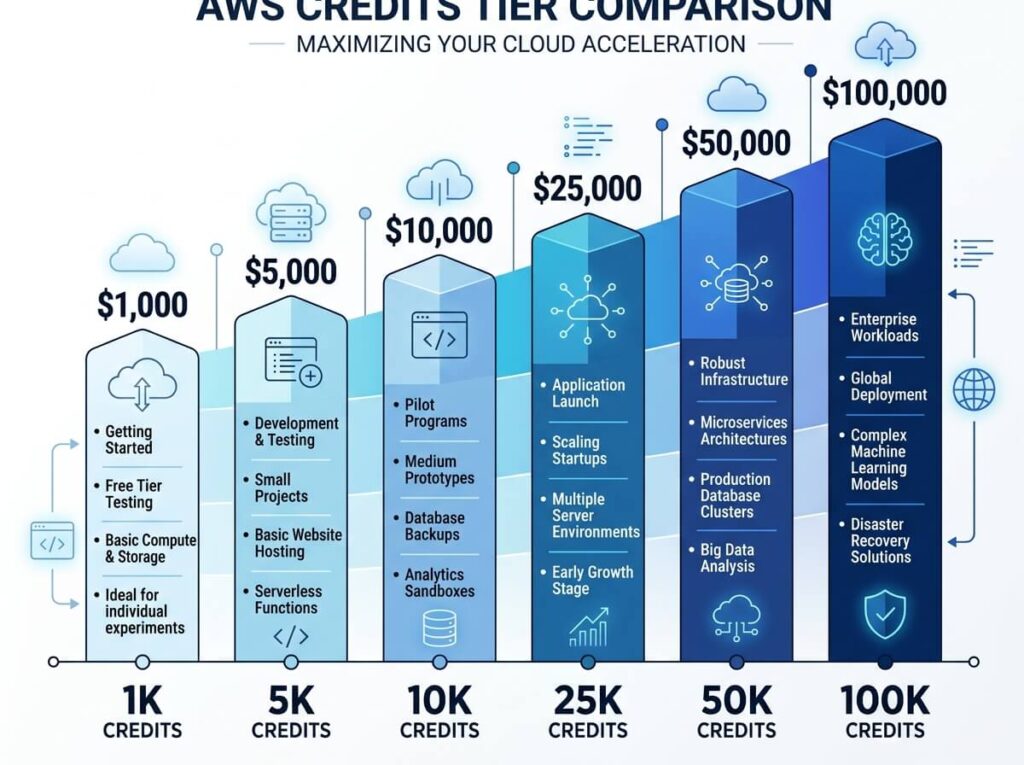
Each tier targets a different stage of startup growth. Here’s a side-by-side look at what typically separates them.
|
Credit Tier |
Best For |
Typical Eligibility |
|---|---|---|
|
$1,000 |
Solo founders and side projects |
Self-funded, AWS Activate Founders |
|
$5,000 |
Early-stage startups testing an MVP |
Bootstrapped startups, select programs |
|
$10,000 |
Startups with early traction |
Accelerator or incubator members |
|
$25,000 |
Growing startups scaling users |
Backed by approved partners |
|
$50,000 |
Funded startups expanding infrastructure |
VC-backed, Tier 1 accelerators |
|
$100,000 |
High-growth startups with heavy usage |
Top-tier VC or accelerator backing |
Eligibility rules change often, so always confirm current requirements on the AWS Activate site.
Which AWS credit tier is right for you?
Who should choose the $1K or $5K tier?
The $1,000 and $5,000 tiers work best for founders in the idea or prototype phase. If you’re building a proof of concept, running small experiments, or hosting a low-traffic app, these amounts go a long way.
At this stage, you’re likely using a handful of services—maybe an EC2 instance, some S3 storage, and a small database. Choose the 1K or 5K tier if keeping costs near zero matters more than reserving large capacity you won’t use yet.
Who should choose the $10K or $25K tier?
The $10,000 and $25,000 tiers suit startups that have found early traction. You have real users, growing data, and infrastructure that needs to stay reliable.
These tiers usually require membership in an approved accelerator, incubator, or VC portfolio. Choose them if you’re past the experiment phase and need room to handle steady growth without cloud costs slowing you down.
Who should choose the $50K or $100K tier?
The $50,000 and $100,000 tiers are built for funded, high-growth startups. If you’re processing large volumes of data, running machine learning workloads, or serving a rapidly expanding user base, these credits can cover serious infrastructure.
Access almost always depends on backing from a top-tier VC or accelerator. Choose the largest tiers only if your usage justifies them—credits expire, and unused balances offer no value.
How can you make your AWS credits last longer?
Getting credits is one thing. Using them wisely is another. A few habits help you stretch your balance:
- Set billing alerts. Configure AWS Budgets to warn you before spending spikes.
- Right-size your instances. Don’t pay for compute you don’t use. Match instance types to actual demand.
- Use auto-scaling. Scale resources up and down based on traffic instead of running at peak capacity around the clock.
- Track expiration dates. Note when credits expire and plan larger projects before that deadline.
- Turn off idle resources. Unused instances, volumes, and IP addresses quietly drain your balance.
Small optimizations add up. Founders who monitor usage closely often make a $10,000 package stretch as far as a careless $25,000 one.
Are AWS credits worth it for startups?
Yes—AWS credits are one of the most practical perks available to startups. They reduce burn rate, free up cash for hiring or product work, and let you test infrastructure without committing real money upfront.
The catch is fit. A $100,000 package sounds appealing, but it delivers no advantage if you only use $8,000 before expiration. The right tier matches your actual usage and growth stage, not your ambition.
Choosing the right tier and next steps
The best AWS credit tier is the one that matches where your startup is right now. Early founders rarely need six-figure packages, and fast-scaling teams shouldn’t settle for $1,000 when they qualify for far more.
Start by estimating your monthly AWS spend, then check your eligibility through AWS Activate or your accelerator, incubator, or VC. Apply for the tier that covers your real needs with a little headroom—and set up billing alerts before you deploy a single service.
Frequently asked questions
How do I qualify for AWS credits?
Most AWS credits come through AWS Activate. Self-funded founders can access smaller tiers directly, while larger tiers usually require membership in an approved accelerator, incubator, or VC portfolio. Requirements change, so check the AWS Activate site for current details.
Do AWS credits expire?
Yes. Most AWS credits expire one to two years after they’re issued. The exact window depends on your credit package, so review your terms and plan larger projects before the deadline.
Can I combine AWS credits from different programs?
Sometimes, but not always. Stacking rules vary by program and package. Some credits can’t be combined, and each may have its own expiration date and service restrictions. Confirm the terms for each credit source before relying on them.
What can AWS credits be used for?
AWS credits apply to eligible services like EC2, S3, RDS, and many others. They usually don’t cover taxes, certain premium services, or third-party AWS Marketplace purchases. Always check which services your specific credits support.
What happens if I don’t use all my AWS credits?
Unused credits simply expire with no refund or rollover value. That’s why choosing a tier matched to your real usage matters more than picking the largest available amount.
Visit here for more information.