
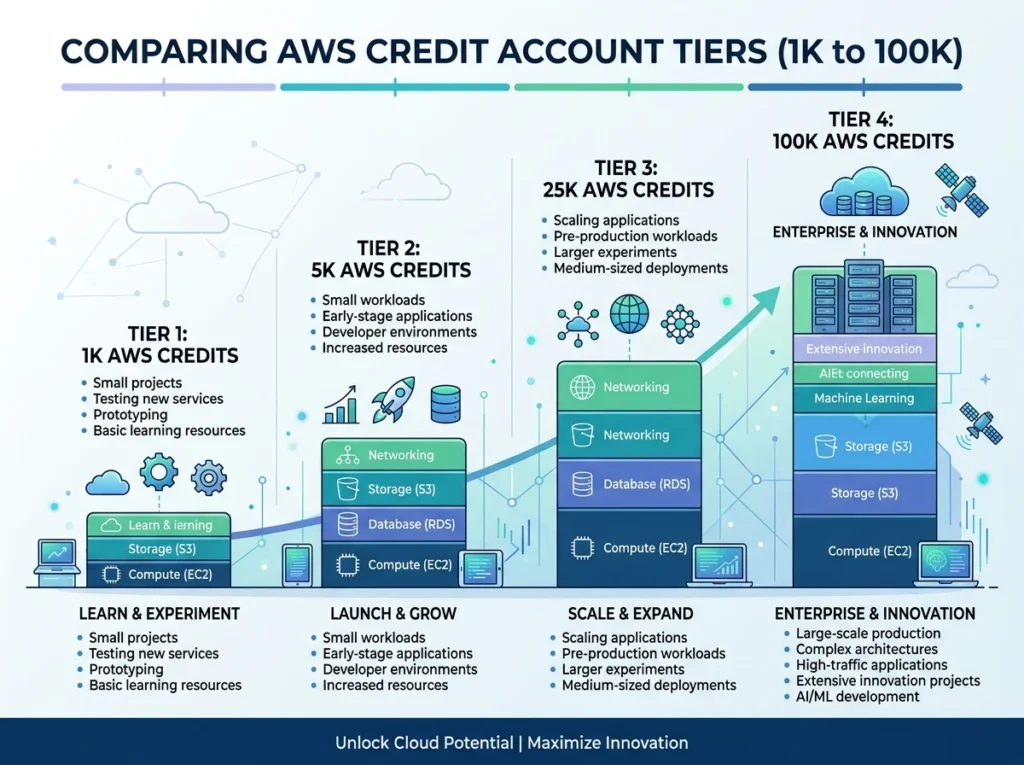
AWS Credit Accounts Compared: 1K to 100K Credits
AWS Credit Accounts Compared: 1K to 100K Credits AWS credits are promotional funds applied to your AWS account to offset cloud computing costs. Credit amounts range from $1,000 (startup accelerator grants) to $100,000+ (enterprise programs like AWS Activate Portfolio). The right tier depends on your company stage, usage needs, and program eligibility. If you’ve ever wondered why some startups run their entire infrastructure on AWS for free while others rack up five-figure monthly bills, AWS credits are often the answer. These promotional funds can dramatically reduce—or even eliminate—your cloud costs during the critical early stages of a business. But not all AWS credit accounts are created equal. A $1,000 credit from an accelerator and a $100,000 enterprise grant serve very different purposes, come with different requirements, and expire on different timelines. Understanding which tier makes sense for your business could save you tens of thousands of dollars. This guide breaks down the major AWS credit tiers, how they compare, and which one you should be targeting. What Are AWS Credits and How Do They Work? AWS credits are promotional balances added directly to your AWS account. Once applied, they automatically offset eligible service charges—compute, storage, databases, machine learning, and more—until the credit balance is depleted or the expiration date is reached. Credits are non-transferable, cannot be converted to cash, and typically expire within 12–24 months of issuance. They also follow a strict application order: AWS applies older credits first, followed by newer ones. If you stack credits from multiple programs, managing expiration dates becomes important. Most credits are distributed through three main channels: AWS Activate — for startups at various growth stages AWS Partner Network (APN) — for consulting and technology partners Promotional and research grants — for academic institutions, nonprofits, and enterprise pilots How Do AWS Credit Tiers Compare from $1K to $100K? $1,000–$5,000: Starter and Accelerator-Level Credits The entry point for AWS credits typically comes through AWS Activate Founders, the self-service tier of AWS’s startup support program. Eligible startups can receive up to $1,000 in AWS credits, plus access to AWS support resources and training. Many startup accelerators and incubators—including Y Combinator, Techstars, and regional programs—also distribute credits in the $1,000–$5,000 range as part of their perks packages. These credits are ideal for: Validating a product or MVP Running small-scale experiments on AWS infrastructure Covering basic compute and storage costs during pre-revenue stages At this tier, credits rarely cover a full year of infrastructure costs for an active product, but they significantly reduce burn rate during early development. $10,000–$25,000: AWS Activate Portfolio The AWS Activate Portfolio tier is where credits start to become genuinely impactful for growing startups. To qualify, your startup must be associated with an AWS Activate Provider—a venture capital firm, incubator, or accelerator that is part of the AWS Activate network. Benefits at this tier typically include: Up to $25,000 in AWS credits (valid for 2 years) AWS Business Support (valued at $1,500/month) Access to AWS technical advisors This tier suits startups that have moved past validation and are scaling their infrastructure. A $25,000 credit can comfortably cover mid-scale workloads—think several EC2 instances, RDS databases, S3 storage, and moderate data transfer costs—for 12 to 18 months, depending on architecture efficiency. To unlock Portfolio benefits, your AWS account must be less than five years old and your startup must not have previously received AWS Activate Portfolio credits. $50,000–$100,000: Enterprise and Strategic Credit Programs At the top of the spectrum, AWS offers credits through select programs aimed at high-growth startups, enterprise pilots, and strategic partnerships. AWS Activate Portfolio (extended offers): Some AWS Activate Providers—typically larger VC firms or AWS’s own investment vehicles—can offer credits up to $100,000 for portfolio companies that demonstrate significant infrastructure needs or strategic alignment with AWS. AWS research and nonprofit grants: Academic institutions and nonprofits can apply for AWS research credits through the AWS Research Credits Program, which also reaches into the $20,000–$100,000 range depending on project scope. Enterprise Discount Program (EDP): Strictly speaking, EDP credits are negotiated commercial discounts rather than promotional credits, but they function similarly for large organizations committing to $1M+ in annual AWS spend. EDP agreements can include upfront credit allotments as part of the deal structure. At this tier, credits are rarely accessible through self-service applications. They typically require a direct relationship with an AWS account manager or a qualifying VC/accelerator partner. Which AWS Credit Tier Is Right for Your Business? The answer depends on three factors: your company stage, your projected AWS spend, and your eligibility. Credit Tier Best For Key Requirement $1K–$5K Pre-product, MVP validation Self-service or accelerator membership $10K–$25K Post-seed, scaling infrastructure AWS Activate Provider association $50K–$100K Series A+, enterprise pilots, research VC relationship or strategic AWS partnership Choose $1K–$5K credits if your team is still building and your infrastructure costs are minimal. The barrier to entry is low, and even modest credits extend your runway. Choose $10K–$25K credits if you’ve raised a seed round or joined an accelerator that participates in AWS Activate. The two-year validity window gives you room to scale without rushing. Choose $50K–$100K credits if your startup is post-Series A, you’re running compute-intensive workloads (ML training, large-scale data pipelines, real-time streaming), or your VC firm has a direct AWS Activate Provider relationship. How to Maximize Your AWS Credits Regardless of Tier Receiving credits is only half the battle. Here’s how to get the most out of them: Monitor expiration dates closely. AWS credits expire, and unused balances are forfeited. Set calendar reminders 90 days before expiration and plan infrastructure expansions accordingly. Use credits on eligible services. Not all AWS services qualify. Marketplace third-party software purchases, support fees, and some managed services are typically excluded. Review AWS’s credit terms before committing your architecture. Stack programs strategically. You can often hold credits from multiple programs simultaneously. Startups affiliated with multiple accelerators sometimes accumulate credits from several sources—just ensure you understand the application order. Right-size your instances. AWS credits don’t last forever. Use the AWS Cost Explorer and Compute Optimizer tools to ensure
AWS Credit Accounts Compared: 1K to 100K Credits Read More »